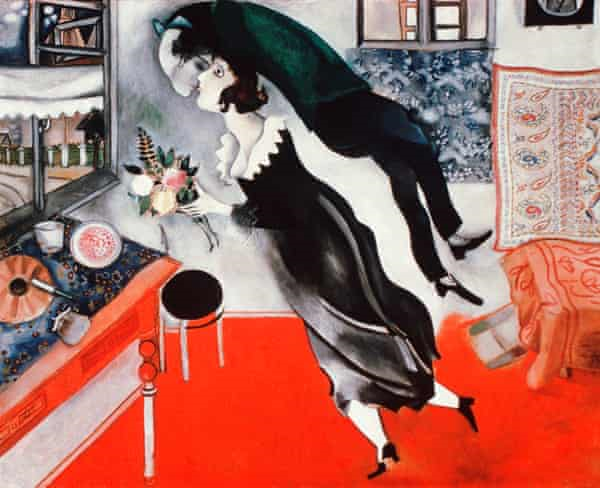
One the great individualists of modern art, Chagall celebrated his Russian and Jewish heritage in his paintings, in a style that blended reality with a magical air of fantasy.”My art is an extravagant art, a flaming vermilion, a blue soul flooding over my paintings.” (1)
In Context La Ruche- Chagall’s style changed rapidly during his first spell in Paris, when he was bombarded with a huge variety of new influences. Many of these came from his fellow inhabitants in the artist colony of La Ruche (the Beehive), where he stayed from 1912-1914 Situated in a run-down part of city and reeking from the stench of nearby slaughterhouses, this ramshackle building provided cheap studios for (mostly) foreign artist. The roll-call of future celebrities who crowded in the “coffins”- the tiny wedge- shaped spaces – included Fernand Leger, Chaim Soutine, and Amedeo Modigliani, along with famous poets such as Guillaume Apollinaire and Blaise Cendrars. (1)
From 1904 to 1940 the history of art is dominated by a sequence of overlapping and interrelated art movements. Chagall rents a studio at La Ruches by them it is home to 140 immigrants. He meets Apollinaire, Picasso and French painter Robert Delaunay (1885-1941). This reveals Chagall’s nostalgia his cultural and religion roots. The combination of floating houses, biblical or Jewish folkloric references and a bright palette became the cornerstone of Chagall’s art. (2)
Chagall ( 1887-1985) who lived in Paris between 1910 and 1914 combined these effects and modern maths like Eiffel Tower with subject matter drawn from his own upbringing to produce dream-like poetic paintings. His paintings combine fantasy, folklore and biblical themes with an intensely surreal quality. Indeed, it is claimed that Guillaume Apollinaire originally coined the term Surrealist to describe Chagall’s paintings. (3)
Marc Chagall, the painter of love, expresses simple feelings through his paintings. From my perspective, his art is a feast for love. I liked the colours that he used in his paintings, the way his painting techniques looked on the canvas. His short brush strokes made it appear as if one colour was blending into another.
Reference list
(1) Andrew Graham-Dixon, Artist Their Lives And Works, pp. 298-299
(2) Stephen Farthing( general editor) ed.Thames & Hudson, Art the whole story. pp. 374-375.
(3) Dr. Mike O’Mahony, World Art The Essential Illustrated History, pp. 36-374.

 1924593 Alina Barticel