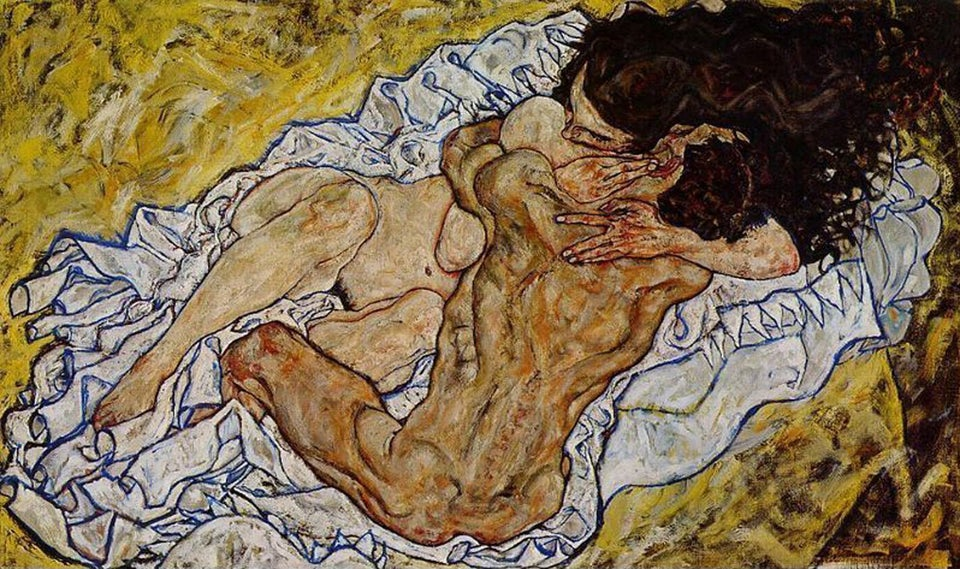
Schiele’s use of colour in this piece is right distinguished by zigzag lines, sine curves lines , and triangles. It is only only in the lower left side of the piece where we see more cyclical shapes forming, but still with the heavy outlining, the picture is distinctly low-dimensional. The human bodies themselves are a distressed view of reality. In general, the outline of the man’s body, especially, though seen in woman’s body as well is rather shaky and abnormally uneven. This gives an unnatural quality to the bodies, making the man seems bony at the knees and elbows despite his supposed muscular build. The body shapes as a whole are also rather elongated. All of these characteristics are elements of Expressionism, which Schiele came to implements and master up until his early death at the age of 28. (1)
Transferred to Vienna and assigned to the Army Museum. He had more time for painting, living at home, with a regular schedule and began at least sixteen major oils that year. Portofolio with twelve reproductions of his drawings published. Invited to exhibit in Vienna, Munieh, Dresden, Amsterdam and Stockholm. Despite growing reputation his poverty and debts continued and at Edith’s urging. He produced many drawings for quick sale. Painted The Embrace and began work on The Family. February 6th death of Gustav Klimt. Schiele sketched him on his deathbed. Schiele’s one-man show at the March exhibition of the Vienna Secession an overwhelming success; he was acclaimed by the press and his works bought for private collections. (2)
Schiele complained in 1910, ‘I wish I could leave Vienna, very soon. How vile it is – everyone envies me and wants to do me down,’ he was not totally unappreciated there. He had had opportunities of exhibiting since 1909, when he was still a student, and could rely on a loyal circle of friends and buyers. He took part in official Austrian exhibitions in Amsterdam, Copenhagen and Stockholm, and in 1917, together with Gustav Klimt, become one of the founders of the Kunsthalle (‘Hall of Art’),the aim of which was ‘that the flight of talent abroad should cease, and that all those whom Aystria has produced should be able to work to Austria’s honour’ (3)
I found fascinating how Egon Schiele combined high art and his adoration for women into his paintings. I believe he is a true feminist who puts women in the centre of his art.
Reference list
(1) Moldred Freguson, Egon Schiele Paintings, pp. 70-71.
(2) Solomon R. Guggenheim (1965), Gustav Klimt and Egon Schiele, New York, pp. 61.
(3) Stephen Farthing( general editor) ed.Thames & Hudson, Art the whole story,pp. 374-375.

 1924593 Alina Barticel