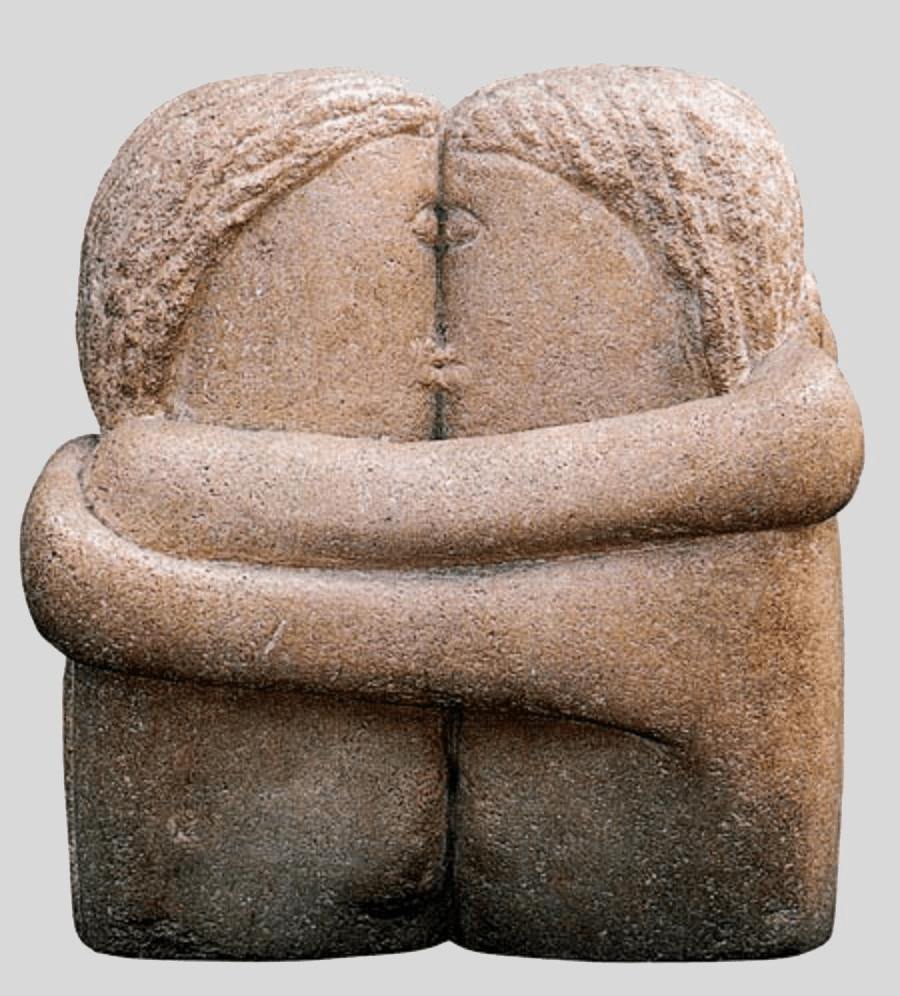
One of the greatest of all the modernists, Brancusi revolutionised sculpture with the extreme simplicity of his forms and pioneered the technique of carving directly into the material. The traditional method of making sculpture was to create a clay or plaster model and then either cast it in bronze or send it off to be carved in marble by specialists. Rodin ran a workshop of numerous assistant, whom he directed in carving the works that he made first as models. For Brancus had been brought up carving wood in rural Romanian -the material itself was key. In carving directly he was able to engage with the stone or wood with an unprecedented immediacy and authenticity, in contrast to the refined methods of casting and modelling. (1)
What my work is aiming at is, above all, realism: I pursue the inner, hidden reality, the very essence of objects in their own intrinsic fundamental nature: this is my only deep preoccupation. His early influences included African as well as Oriental art. Although Robin was another early influence, Brancusi decided he wished to make much simpler pieces, and began an evolutionary search for pure form. He reduced his work to a few basic elements. Paradoxically, this process also tended to highlight the complexity of thought that had gone into its making. Monumental, subtle and intimate, Brancusi’s sculpture are rightly now considered to be the work of a modern master. (2)
I love the sculpture because I see the beautiful embody utter enrapture of two people. Simple love! This was a rock in which Brancusi saw something else, and to me that is genius. For me, sculptor’s work is magic, a mystery of artistic creation.
(1) Andrew Graham-Dixon, Artist Their Lives And Works, pp. 218
(2) Joseph Manca, Patrick Bade, Sarah Costello (-). 1000 Sculptures Of Genius, 1496.

 1924593 Alina Barticel