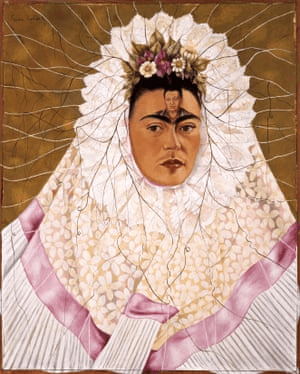
Hailed as a feminist icon, enigmatic Mexican painter Kahlo is best known for her vibrant, starting, sometimes nightmarish self-portraits, often seen as chronicles of physical and emotional anguish.Breton, for example, was the first to describe her work as Surrealist. Kahlo herself consistently defied such labels: “I never painted dreams,” she said, “I painted my own reality.” (1)
Andre Breton visited and stayed with Frida Kahlo and her husband Diego Rivero during his visit to Mexico in 1938, acknowledge that she was a self-invented Surrealist. The fact that Breton wrote the preface to Kahlo’s exhibition did not qualify her as a Surrealist: in fact, she eschewed the term. Although her pictorial fantasies are often associated with a Surrealist aesthetic, she painted not her dream or imagination but what she saw as her own nightmarish-reality. In 1925 a serious road-traffic accident left her very badly disability. Often confined to a hospital bed for weeks undergoing reconstructive surgery, she constructed an image of two Fridas in order to exorcise the pain and yet maintain a sense of reality. She subsequently discovered that she was unable to conceive children and in a particularly poignant self-portrait, Henry Ford Hospital (1932), Kahlo is seen haemorrhaging after suffering a miscarriage. Although her husband Diego Rivera supported her artistically, the relationship was always very tense, overshadowed by the fact that Rivera was Mexico’s most famous living artist. Kahlo depicted this dominance in the painting Frida and Diego Rivera(1931), while their separation and her subsequent loneliness was depicted in The Two Fridas (1939). (2)
Andre Breton, the arch-apostle of Surrealism, neatly described her art as like a ribbon tied around a bomb. (3)
I believe, Frida express in this painting that her heart had always belonged to Diego, her soul mate. She is a great artist, a paradox, she was recognised for who she was. Frida has channelled feelings of heartbreak into her work.
Reference list
(1) Andrew Graham-Dixon. Artist Their Lives And Works. p. 326.
(2) Camillia de la Bedoyere, Ihor Holubbizky, Dr Julia Kelly (2006), A Brief History of Art, The Foundry Creative Media Company Limited. p.324.
(3) Dr. Mike O’Mahony. World Art The Essential Illustrated History, p. 304.

 1924593 Alina Barticel